Winter car rental in Iceland
What you need to know
Our fleet runs suitable winter tyres in season. Iceland requires tyres appropriate to the conditions; studded tyres are permitted (not mandatory) during the winter period, roughly 1 November to 15 April, with at least 3 mm tread recommended (FÍB guidance). AWD or a proper 4×4 is strongly recommended for winter Ring Road travel; a front-wheel-drive car on winter tyres is marginal in bad conditions. Daylight is short (as little as 3–5 hours in December) and weather can change within hours — check road.is before every day on the road.
Winter tyres: required by law, included in your rental
Icelandic law mandates that rental vehicles be fitted with winter tyres during the winter season. Our fleet runs on studded winter tyres from approximately 1 November through 15 April, meeting the FÍB (Icelandic Automobile Association) minimum 3 mm tread standard. Winter tyres are not an extra — they are included in your rental.
If you are renting in October or late April — the shoulder months either side of the legal season — the tyre type on your specific car depends on the exact date and fleet rotation. Always confirm at booking if your dates straddle the changeover period.
Which drivetrain for winter: AWD or 4×4?
Both are better than front-wheel drive on Icelandic winter roads. The right choice depends on your route:
- Compact AWD SUV: the right choice for the Ring Road and standard tourist routes in winter. More traction than 2WD, fuel-efficient, easy to drive in icy conditions. Our Comfort category includes AWD models like the Dacia Duster and Toyota RAV4 with winter tyres fitted.
- Proper 4×4: worth it if you are heading to the Westfjords, Snæfellsnes Peninsula in rough conditions, or any route where you might encounter deep snow, icy mountain passes, or need the extra ground clearance. Our 4×4 & Jeep category includes vehicles with genuine four-wheel drive and high clearance.
Checking road conditions: road.is is essential
road.is (Vegagerðin — the Icelandic Road and Coastal Administration) provides live road status, closures, ice warnings, and F-road opening dates. Check it every morning before driving. In winter, sections of Route 1 can close temporarily for storms or ice, and mountain passes may be restricted to 4×4 vehicles only on specific days.
Weather forecasts in Iceland are short-range reliable (12–24 hours) but longer forecasts are uncertain. A mild morning can become a storm by afternoon, particularly on the south and east coasts. Build flexibility into your itinerary rather than committing to strict daily targets.
Daylight hours in winter Iceland
Daylight hours in Reykjavík
Indicative hours of daylight per day — plan your driving windows accordingly.
| Month | Approx. daylight (hours) | Planning note |
|---|---|---|
| January | 5 hours | Still short — plan shorter driving days |
| February | 8 hours | Noticeably more light; good for driving |
| March | 12 hours | Spring approaching; roads improving |
| April | 15 hours | Great touring month — light evenings begin |
| May | 18 hours | Long bright evenings; near-midnight sun |
| June | 21 hours | Nearly 24-hour daylight — midnight sun |
| July | 20 hours | Peak summer — warmest month |
| August | 16 hours | Still long days; eclipse month (12 Aug 2026) |
| September | 13 hours | Autumn colours; first northern lights chances |
| October | 9 hours | Shortening fast; winter tyres may be on |
| November | 6 hours | Winter — plan 2–3 stops per day |
| December | 4 hours | Shortest days; mostly dark |
Hours are indicative for Reykjavík (southwest Iceland); northern Iceland has slightly less daylight in deep winter. Figures vary by weather and exact latitude.
| Month | Approx. daylight (Reykjavík) | Planning note |
|---|---|---|
| November | ~5–6 hours | Good for northern lights; plan 2–3 stops per day |
| December | ~3–4 hours | Shortest days; most driving in darkness or dusk |
| January | ~4–5 hours | Increasing — still plan for short driving windows |
| February | ~7–8 hours | Noticeably more light; good winter driving month |
| March | ~11–12 hours | Spring approaching; roads improving; still cold |
Hours are indicative and vary by latitude and weather. Figures are for Reykjavík; the north of Iceland has slightly less daylight in deep winter.
F-roads are closed in winter
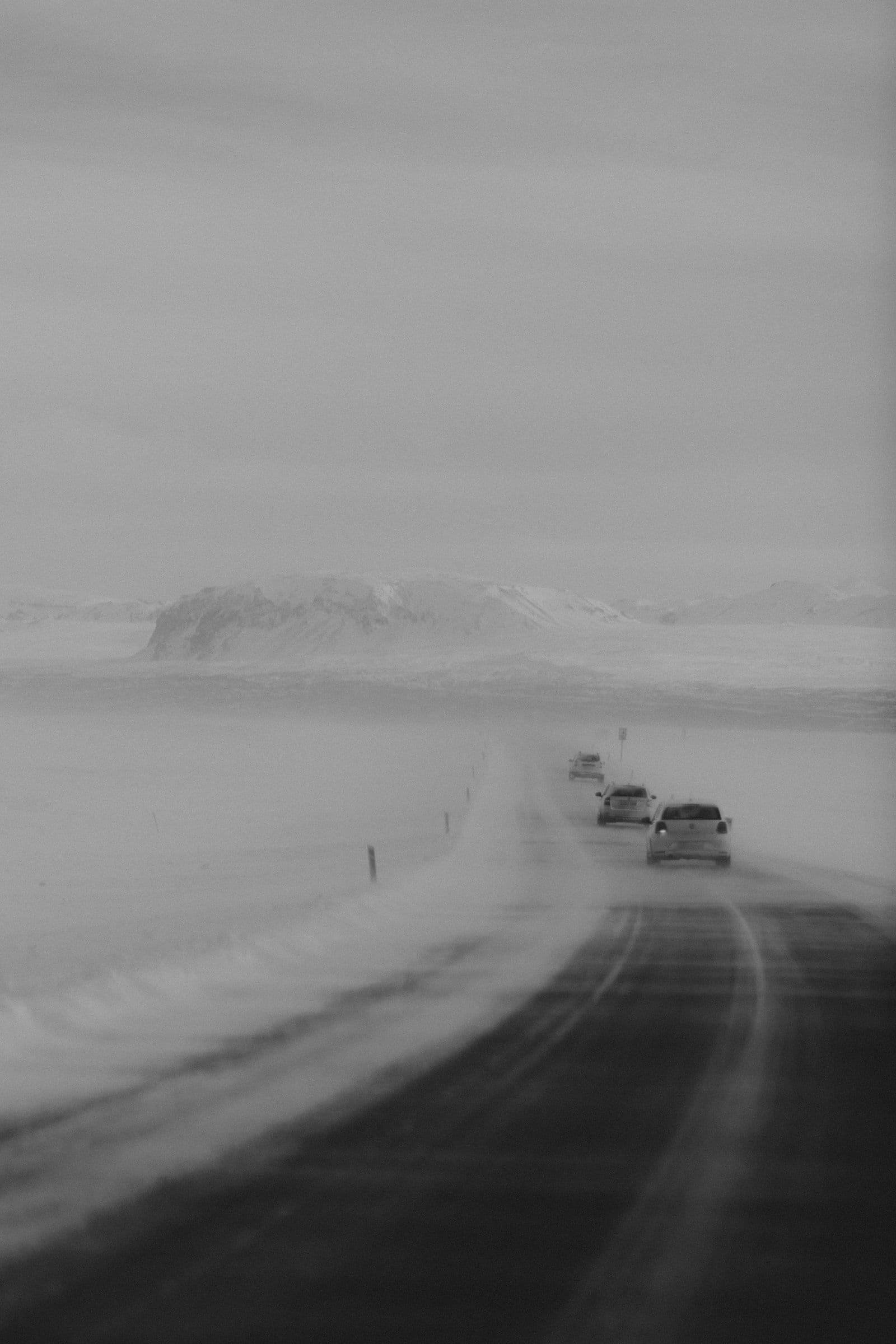
F-roads (Highland mountain tracks) are closed from approximately September/October through to late June or July — they are summer-only routes. Attempting F-roads in winter can void cover under the rental terms and is extremely dangerous. Read our F-roads guide for the full rules.
Practical winter driving tips
- Check road.is every morning before driving — closures and ice warnings update frequently.
- Drive to conditions, not the speed limit — Iceland's limits assume dry roads in good visibility.
- Keep the fuel tank above half in remote areas — fuel stations are far apart in the east and north.
- Brake gently and early on ice — studded tyres grip well but stopping distance is still longer than summer.
- Do not open car doors into the wind carelessly — Iceland's gusts can rip a door off its hinges.
- Tell someone your itinerary if driving remote routes; mobile coverage disappears in parts of the Ring Road.
- Pack a windscreen scraper, torch, and warm clothing as backup — even for short drives.
Related guides
Check our winter fleet
All vehicles include winter tyres in season. AWD models available in both Compact SUV and 4×4 categories.
Common questions
Are winter tyres included in Icelandic rental cars?
Yes. Icelandic law requires rental operators to fit winter (studded) tyres from approximately 1 November to 15 April — minimum 3 mm tread as per FÍB guidelines. Our fleet is fitted on this schedule. If you are renting in the shoulder months (October or April), confirm at booking whether winter rubber will be on the car.
Do I need a 4×4 for winter driving in Iceland?
AWD with winter tyres is strongly recommended for the Ring Road in winter. A proper 4×4 adds further ground clearance and low-range gear — worth it if you plan to visit the Westfjords, Snæfellsnes, or remote highland roads in winter conditions. A front-wheel-drive car with winter tyres can manage the Ring Road in mild winter weather but is underpowered for the worst conditions Iceland delivers.
What are driving conditions like in Iceland in winter?
Highly variable. A clear, cold morning can turn into a whiteout or icy road within a few hours. Daylight is extremely short in December and January (3–5 hours). Some sections of Route 1 close temporarily in severe weather. Check road.is every morning before setting out, drive to conditions rather than speed limits, and budget more time between stops than in summer.
Can I drive to Landmannalaugar or F-roads in winter?
No. F-roads (the Highland mountain tracks) are closed in winter — typically from September or October until late June or July depending on conditions. Attempting F-roads in winter is dangerous and can void cover under the rental terms. Check road.is for current F-road status.
Is Iceland worth visiting in winter for driving?
Absolutely — the northern lights, winter landscapes, and glacier walks are unique to the season. The Ring Road remains open (with occasional temporary closures) and is manageable in an AWD vehicle with winter tyres. Just plan for shorter days, slower driving, and more flexibility in your itinerary.
Last updated: 25 June 2026